How to Take a Child’s Temperature, and What the Reading Means
A thermometer measures temperature. It does not diagnose anything, and no reading from any device replaces a conversation with your paediatrician. What a good thermometer and good technique give you is a consistent number you can report accurately.
Why consistency matters more than absolute accuracy
What a clinician usually wants to know is the trend: is the temperature rising, holding or falling, and over what period. A device that reads consistently, even if it reads slightly high or low, gives you that trend.
Switching between a forehead reading at lunchtime and an ear reading at midnight introduces a difference that is a property of the method rather than of the child.
Pick one device and one site and use it throughout an illness.
Touchless forehead thermometers
An infrared forehead thermometer reads the temporal artery through the skin and gives a result in a second or two without contact, which is why it has become the default for sleeping children.
Technique matters more than with any other type. Hold it at the distance the manufacturer specifies, aim at the centre of the forehead, and make sure the skin is dry, uncovered and has not just been against a pillow or a cold window.
Sweat, hair, a hat or a recently applied cold cloth will all shift the reading.
Ear thermometers
Tympanic thermometers read the eardrum and are quick and generally reliable in children over about six months. Below that age the ear canal is small enough that positioning is difficult and results are inconsistent.
Gently pull the ear back and up for an older child, or straight back for a younger one, to straighten the canal. A probe aimed at the canal wall rather than the drum will read low.
Earwax and a recent ear infection both affect readings.
Multi-mode devices
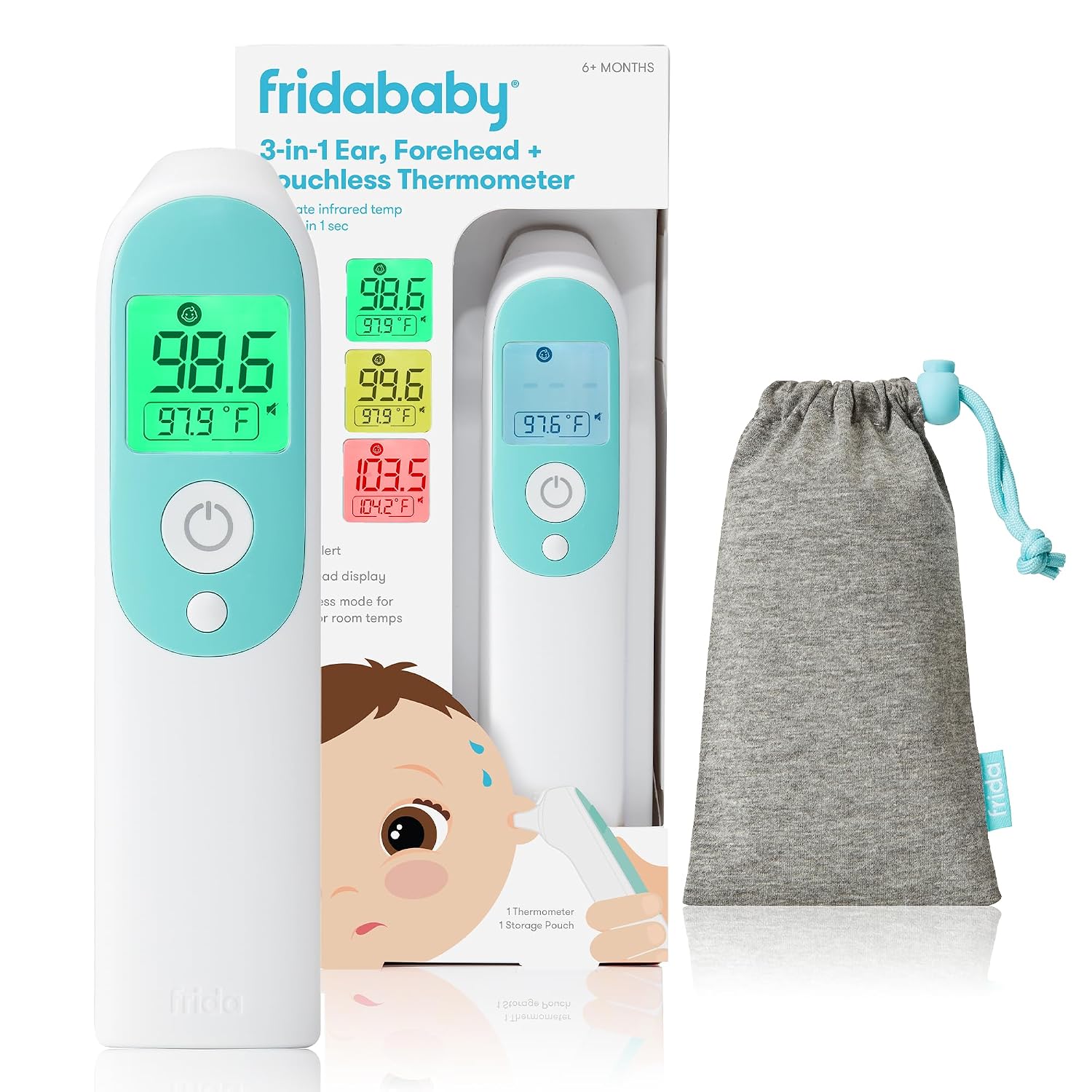
Combination devices that offer ear, forehead and touchless modes are convenient, and the important thing is to record which mode you used. The modes are not interchangeable and manufacturers calibrate them separately.
Some devices apply an internal adjustment to estimate core temperature from a surface reading. Where they do, that is a modelled number, and knowing that helps when comparing to a clinic's reading.
Read the manual once. These devices have more settings than people expect, including a silent mode that is genuinely useful at night.
Environment and timing
Let a thermometer sit in the room for at least fifteen minutes before use. A device brought in from a cold hallway will read low until it equalises.
Avoid taking a reading immediately after a bath, a feed, crying, or being wrapped in blankets. Wait twenty minutes or so for the skin to settle.
Take readings at roughly the same times each day when tracking an illness, since body temperature naturally varies through the day.
Recording readings usefully
Write down the time, the number, the site and the device. A note that says 38.4 at 21:10, forehead, is far more useful to a clinician than a memory of it being high last night.
Note what else was happening: fluids taken, medication given and when, behaviour, appetite. Temperature is one input among several.
A phone note is fine. The point is that you are not reconstructing it later.
What we will not tell you
We do not publish threshold numbers, treatment guidance or advice about when to seek care, because that depends on the child's age, history and other symptoms, and it is a clinician's judgement rather than a retailer's.
Your paediatrician, a nurse advice line or your local health service will give you guidance specific to your child. If you are worried, contact them rather than a product page.
What we can tell you is how to get a reading you can trust and report.
Cleaning and battery care
Wipe the probe or sensor with a soft cloth after use. For ear thermometers with disposable covers, use a fresh one each time; without a cover, clean the probe tip with an alcohol wipe and let it dry fully.
Do not immerse any infrared thermometer or run it under a tap. The sensor is not sealed.
Change batteries at the first low-battery indication. A device with a weak cell can produce erratic readings before it refuses to work.
Where to go next
Touchless and ear thermometers are in Health & Thermometers. We list what each device measures and nothing beyond that.
Shop Health & Thermometers
Related articles